Showing posts with label recycle. Show all posts
Showing posts with label recycle. Show all posts
Friday, June 20, 2014
Planta de Clasificación de Envases en Montevideo
Iniciativa de la Intendencia de Montevideo para la formalización de la gestión de residuos sólidos:


Monday, April 15, 2013
A apoyar la iniciativa para reciclar en ciudad de Las Piedras, Uruguay
 Una nueva iniciativa busca fomentar la separacion de residuos orgánicos de residuos reciclables en
los domicilios de la ciudad de Las Piedras.
Una nueva iniciativa busca fomentar la separacion de residuos orgánicos de residuos reciclables en
los domicilios de la ciudad de Las Piedras.Como saben los que vienen siguiendo nuestras busqueda de una vida mas sustentable, el separar los residuos es una de las formas mas faciles de disminuir la cantidad de nuestros desechos.
Aplausos por la iniciativa de Las Piedras y a colaborar. Para mas informacion pueden ir al blog del programa Las Piedras Recicla o a su pagina en Facebook.
Y al resto de las ciudades del pais, a ver si se suman a la iniciativa.
Saturday, March 30, 2013
Upcycle styrofoam into print art material
 |
| (CC) OSJ |
Because it doesn't require the very sharp carving tools traditional used for block-printing, Styrofoam-printing is a perfect art project for kids (as you can see can here and here and pretty much anywhere there's a website for crafts+recycle+kids). Any round-pointed thingy would do as carving tool (I used the other side of the brushes), although if you want finer detail, you would need something thinner.
 |
| (CC) OSJ |
 |
| (CC) OSJ |
Most websites show foam rollers being used to spread the paint, but I imagine dabbing with a sponge would do the trick as well. I used a thick brush, and I can guess kids would have fun applying the pain with their fingers as well.


The Styrofoam printing blocks can be saved and used later to experiment with different techniques or to combine them in bigger pictures.

Tuesday, March 5, 2013
Reducí, reusá, reciclá: faltan 19 días para la Hora de la Tierra
 |
| (c) Angus Hyland |
"Green is a shorthand for the environment - but for some reason graphically we tend to treat it as a block colour, ignoring all the variety that occurs in nature. So I decided to redraw the recycling symbol using as many different shades of green as possible, highlighting the many different ways to save the planet. As an added bonus, it gave me a nice pun for the title."
[Hace referencia al best-seller '50 sombras de gris' que con su éxito ha disparado una porrada de títulos tipo '50 X de Y']
Me rechina un poco lo de "salvar al planeta" por lo antropocéntrico, pero la idea vale igual, de que existen muchos caminos hacia el mismo objetivo de ser un poco más 'gentle' en nuestro 'footprint'.
[Feeling Spanglish-y today y channeling my inner Spaniard al mismo tiempo, para quienes pueden percibir las subtleties of the Spanish language. But I digress...]
No les doy más la lata, que sobre el tema ya vengo posteando hace rato. Para una lista de entradas relacionadas al tema triple R, ir acá.
Sunday, February 24, 2013
Ideas para reutilizar botellas de plástico IV: huerta
Después de todos estos ejemplos ya estarán prontos para pasar a temas mayores. ¿Qué tal un invernadero para la huerta?
 También esta la versión haragana que yo uso, menos impresionante pero bastante efectiva: un invernadero individual para cada plantita. Es ideal para proteger los brotes cuando aún están muy vulnerables, pero con una botella grande, de varios litros, sirve también para plantas más grandes.
Si insiste en un invernadero en serio pero con un acabado diferente, se puede optar por techo de tejas, es decir, tejas hechas a partir de botellas de plástico. ¿Por qué no?


Si insiste en un invernadero en serio pero con un acabado diferente, se puede optar por techo de tejas, es decir, tejas hechas a partir de botellas de plástico. ¿Por qué no?

Ideas para reutilizar botellas de plástico III: jardín
Después que tenemos la casa limpia y ordenada, toca salir al jardín y seguir encontrando nuevos usos para las botellas de plástico.
Re-utilizar en el jardín
 El uso más obvio y común es el que vemos en la primera foto: como contenedor para plantas.
En el diagrama de abajo vemos un uso un poco más sofisticado, ya que permite drenar el agua que sobra y volver a utilizarla. Es cuestión poner una parte de la botella encastrada en la otra y utilizarla de almácigo.


A la hora de regar las plantas, surge otra oportunidad de re-utilizar
otra botella. Esta vez, se agujerea la botella, se ata la manguera al
pico de la botella y voilá, un regador improvisado. Para los muy
sofisticados, se puede poner la botella sobre rueditas.
Ideas para reutilizar botellas de plástico II: organización
Otros ejemplos para re-utilizar botellas dentro del hogar.
En el ejemplo siguiente una botella de shampoo termina siendo un recipiente para colgar y recargar el teléfono, práctico y decorativo.

Aún más simple es la solución que encontraron para cerrar bolsas de plástico de manera hermética. Super fácil de abrir y volver a cerrar.

Re-utilizar en la organización
En el ejemplo siguiente una botella de shampoo termina siendo un recipiente para colgar y recargar el teléfono, práctico y decorativo.

Aún más simple es la solución que encontraron para cerrar bolsas de plástico de manera hermética. Super fácil de abrir y volver a cerrar.

Ideas para reutilizar botellas de plástico I: limpieza
Hay muchas ideas sobre como reutilizar las botellas de plástico - desde las más simples y obvias, hasta algunas que implican un poquito más de elaboración. En las siguientes estradas mostramos algunas para la limpieza y organización de la casa, el jardín y hasta la construcción.
 A partir de botellas con mangos se puede sacar diferentes tipos de palitas. No se necesita nada más que un par de tijeras y cortar por la línea de puntos que muestra el diagrama.
Después, con varias botellas de bebidas y un poco más de manualidad y paciencia, puede hacerse de una escoba. Y como ya tiene la palita, ¡a barrer!
¿Dónde tirar lo barrido? En una papelera o basurero también hecho de botellas de plástico. Parece una idea particularmente buena para basureros en espacios públicos para disuadir el vandalismo.


Pueden ver otros usos en la organización de la casa, el jardín o la huerta.
Antes ya habíamos publicado ejemplos de usos de botella en la casa y el jardín o la huerta.
Re-utilizar en la limpieza
 A partir de botellas con mangos se puede sacar diferentes tipos de palitas. No se necesita nada más que un par de tijeras y cortar por la línea de puntos que muestra el diagrama.
Después, con varias botellas de bebidas y un poco más de manualidad y paciencia, puede hacerse de una escoba. Y como ya tiene la palita, ¡a barrer!
¿Dónde tirar lo barrido? En una papelera o basurero también hecho de botellas de plástico. Parece una idea particularmente buena para basureros en espacios públicos para disuadir el vandalismo.


Pueden ver otros usos en la organización de la casa, el jardín o la huerta.
Antes ya habíamos publicado ejemplos de usos de botella en la casa y el jardín o la huerta.
Thursday, February 21, 2013
Good intentions gone bad: what might happen to your donated clothes
A recent video by Oxfam through an article by Do The Green Thing reminded me of something I wrote last year while in Africa about good intentions gone awry. That situation sadly happens too often in international development and for that reason, it’s up to us to do the research and inform ourselves as best as possible, ask questions, and challenge simplistic answers.
While there are some things we might never have a definite answer for, I re-post what I published earlier to show another perspective and add to the discussion:
---
“What do you think of international development?”, asked our new friend Joca.
“Do you want the political correct answer or the cynic one?”, retorted Fadi.
 The truth is, international development has been heavily criticized in the last couple of decades. And not without reason. Fortunately, I don’t think anybody is so naive anymore to buy into the “Oh, we’ll go and save the world” kind of mentality. As pitfalls and mistakes have been exposed, people and organizations have become more savvy about how to generate positive change around the world.
One clear case of good intentions gone wrong was exposed in the documentary “The T-Shirts Travels.” The film shows how secondhand clothing, given away as charity in the West, ends up in Zambia (Mozambique’s neighbor to the northwest), enriching the middle person and ruining the local clothing industry in the process.
‘Every single clothing factory in Zambia went out of business; we do not have a clothing industry left in the country because the secondhand clothes are coming in.’ Mark O’Donnell, spokesman, Zambian Manufacturers Association
You can see the PBS 50-min documentary here:
https://www.youtube.com/watch?v=_iDNtwVL4sw
Want to know more about the issue? You can read about it here.
Friday, December 14, 2012
An organic and a recycled Xmas: sustainable Christmas trees
You probably know about how millions of trees are cut and end up in the landfills every Christmas year after serving as decorations for a couple of weeks. An easy way to avoid such waste is to opt for other type of trees that will serve the same function without harming the environment.
 This week, I came across two examples I loved.
This one on the right is made out of used paper. It came into being thanks to the magic hands of my very talented friend Minati, who we have previously encountered in this blog doing beautiful objects with paper. A lot of used paper, a stapler, and voilà: a perfectly fine Christmas tree.
The instructions, according to tree-maker Minati are: "about 50 pages (more is better). I wanted a big tree, so I glued newspapers together into a book first, let it set, and then folded. If you want to get the kids involved, let them do the folding first, and then glue! Otherwise just give them magazines and let them make their own little trees!"
If you need more detailed instructions than that (I know I do!), you can check them here.
In a way you don't get more tree-like than that: a tree that became paper that became a tree. *Like* circles.
The other example I run into takes all the prizes in my book for creativity and sustainability: a Fungal Christmas Tree!
 It was created on a petri dish out of fungi. Definitely, the first time I see something like it. The geeky-quotient makes it appropriate for The Big Bang Theory show, but I don't think one can get more sustainable than that.
Curious about how it was done? Here's the only info I have:
Top: Talaromyces stipitatus
Tree: Aspergillus nidulans
Ornaments: Penicillium marneffei
Trunk: Aspergillus terreus.
The instructions for that one? You'll have to ask a biologist about that.
If anyone has the information on who came up with it, or anything to add about how it's done, please share.
If you would like a less work-intensive option, check here.
 This week, I came across two examples I loved.
This one on the right is made out of used paper. It came into being thanks to the magic hands of my very talented friend Minati, who we have previously encountered in this blog doing beautiful objects with paper. A lot of used paper, a stapler, and voilà: a perfectly fine Christmas tree.
The instructions, according to tree-maker Minati are: "about 50 pages (more is better). I wanted a big tree, so I glued newspapers together into a book first, let it set, and then folded. If you want to get the kids involved, let them do the folding first, and then glue! Otherwise just give them magazines and let them make their own little trees!"
If you need more detailed instructions than that (I know I do!), you can check them here.
In a way you don't get more tree-like than that: a tree that became paper that became a tree. *Like* circles.
 |
| Photos of tree (c) Minati Baro |
The other example I run into takes all the prizes in my book for creativity and sustainability: a Fungal Christmas Tree!

Curious about how it was done? Here's the only info I have:
Top: Talaromyces stipitatus
Tree: Aspergillus nidulans
Ornaments: Penicillium marneffei
Trunk: Aspergillus terreus.
The instructions for that one? You'll have to ask a biologist about that.
If anyone has the information on who came up with it, or anything to add about how it's done, please share.
If you would like a less work-intensive option, check here.
Thursday, December 13, 2012
Orchestra out of recycled instruments: what a treat
If you have been reading the blog, you know we love it when things (whether coffee bags, plastic bottles, magazines and newspapers or supermarket carts) get a second life instead of ending in the landfill.
I just found another superb example on how out of an oil can, a fork, a meat tenderer and other random objects found in a landfill, a community in Paraguay have been making violins, cellos and other instruments, creating an orchestra out of recycled materials: The Recycled Orchestra. Isn't that cool or what?
Here is a photo of the violins:
From their look you wouldn't imagine how great they sound. Don't believe me? Check it in this short video:
They are making a documentary about it called Landfill Harmonic. If you want to find out more you can visit them on Facebook or on their website. Looking forward to seeing the documentary when it comes out.
I just found another superb example on how out of an oil can, a fork, a meat tenderer and other random objects found in a landfill, a community in Paraguay have been making violins, cellos and other instruments, creating an orchestra out of recycled materials: The Recycled Orchestra. Isn't that cool or what?
Here is a photo of the violins:
 |
| Violins out of recycled materials. |
From their look you wouldn't imagine how great they sound. Don't believe me? Check it in this short video:
They are making a documentary about it called Landfill Harmonic. If you want to find out more you can visit them on Facebook or on their website. Looking forward to seeing the documentary when it comes out.
Wednesday, July 18, 2012
Día de limpieza de playas en Costa del Sol, Maputo
Maputo, la capital de Mozambique, tiene la triste fama de estar entre las 25 ciudades más sucias del mundo.
Según del index de salud y sanidad Mercer, Mozambique “suffers from lack of sanitation processes--specifically the lack of a solid waste removal system as well as sewage treatment. The capital city of Maputo feels the worst of these consequences. Piles of garbage line the streets, and the sewage in the river is visibly thick.” Mmmm. Lindo.
Es por eso que aprovechamos la oportunidad de participar (si lo habíamos hecho en el Atlántico, ¿por qué no en el Índico?) en la iniciativa de limpieza de la playa de Costa del Sol, al norte de la ciudad. El evento estuvo organizado por el departamento de responsabilidad social de el Banco Millenium BIM, la Escuela Portuguesa, la Escuela Primaria da Polana Caniço A y la organización no gubernamental Associação Moçambicana de Reciclagem (A.M.O.R.).
Se empezó temprano para evitar el calor del mediodía, pero siguió sumándose gente toda la mañana.
Botellas de cerveza de vidrio, latas de referezco, paquetes y colillas de cigarrillos, bolsas, botellas de agua de plástico, envoltorios de comida, cajas de jugos de cartón, tapitas de metal, embalajes de styrofoam... encontramos basura de todo tipo.


En general, todos demostraban muy buena voluntad, pero algunos de los niños parecían más preparados que otros. Uno de los niños de la escuela primaria, en vista que no le habían entregado una bolsa todavía, empezó tímidamente a alcanzarme basura para agregar a mi bolsa. Pero parecía que no le habían explicado muy bien en qué consistía el asunto del reciclaje, porque me traía pedazos de madera, algas, hojas.
Cuando además vi que estaba juntando las cosas sin los guantes le ofrecí uno de los míos. Sin decirme una palabra, sacó los suyos del bolsillo de su pantalón: simplemente hacía demasiado calor para usarlos.
Explicación mía mediante, seguimos juntando sólo basura y con los guantes puestos. En todo el trayecto no logré sacarle más que un sí o un no, pero enseguida llenamos dos bolsas enteras.

A la llegada, estaba uno de los contenedores de A.M.O.R., los “Ecopontos”, donde las gestoras organizaban la selección de material reciclable.
A los participantes agotados después de la caminata por la arena al rayo del sol los esperaban con refrescos y merienda.


 |
| Punto de partida, donde se le entregaba a los participantes guantes, máscaras, bolsas y rastrillos. Se organizaron partidas de cuatro personas cada una para recoger papel, plástico, vidrio y latas. |
Según del index de salud y sanidad Mercer, Mozambique “suffers from lack of sanitation processes--specifically the lack of a solid waste removal system as well as sewage treatment. The capital city of Maputo feels the worst of these consequences. Piles of garbage line the streets, and the sewage in the river is visibly thick.” Mmmm. Lindo.
Es por eso que aprovechamos la oportunidad de participar (si lo habíamos hecho en el Atlántico, ¿por qué no en el Índico?) en la iniciativa de limpieza de la playa de Costa del Sol, al norte de la ciudad. El evento estuvo organizado por el departamento de responsabilidad social de el Banco Millenium BIM, la Escuela Portuguesa, la Escuela Primaria da Polana Caniço A y la organización no gubernamental Associação Moçambicana de Reciclagem (A.M.O.R.).
 | ||
| Mucho trabajo por hacer |
Botellas de cerveza de vidrio, latas de referezco, paquetes y colillas de cigarrillos, bolsas, botellas de agua de plástico, envoltorios de comida, cajas de jugos de cartón, tapitas de metal, embalajes de styrofoam... encontramos basura de todo tipo.


En general, todos demostraban muy buena voluntad, pero algunos de los niños parecían más preparados que otros. Uno de los niños de la escuela primaria, en vista que no le habían entregado una bolsa todavía, empezó tímidamente a alcanzarme basura para agregar a mi bolsa. Pero parecía que no le habían explicado muy bien en qué consistía el asunto del reciclaje, porque me traía pedazos de madera, algas, hojas.
 |
| Hasta los más chiquitos colaboraron |
Cuando además vi que estaba juntando las cosas sin los guantes le ofrecí uno de los míos. Sin decirme una palabra, sacó los suyos del bolsillo de su pantalón: simplemente hacía demasiado calor para usarlos.
Explicación mía mediante, seguimos juntando sólo basura y con los guantes puestos. En todo el trayecto no logré sacarle más que un sí o un no, pero enseguida llenamos dos bolsas enteras.

 |
| Impresionada por el entusiasmo de este chiquito |
 |
| Fadi no dejó que se le escapara ni el más mínimo pedacito de vidrio |
A la llegada, estaba uno de los contenedores de A.M.O.R., los “Ecopontos”, donde las gestoras organizaban la selección de material reciclable.
 |
| Punto de llegada: Ecoponto |
A los participantes agotados después de la caminata por la arena al rayo del sol los esperaban con refrescos y merienda.


Más tarde hubo música en vivo, juegos para aprender a separar los diferentes materiales, carreras cargando agua en la cabeza, competencias de construcción de castillos de arena y diversión con cometas para todos los niños.
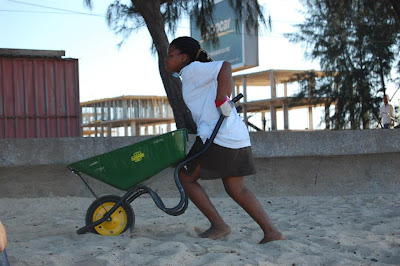
Viendo el esfuerzo que pone la gurisa de esta foto, me recuerda la cita
“Nunca dudes que un pequeño grupo de ciudadanos considerados y comprometidos pueda cambiar el mundo. De hecho, es la única cosa que ha logrado hacerlo.”

Party decorations and lamps made out recycled paper
I love paper. I love paper notebooks and paper magazines and paper books (as opposed to iPads, e-zines and e-books). I love the feel of paper. Recycled paper? I’m in heaven.
Ok, I’m weird. But I’m not the only one. And in Maputo I’ve found a kindred spirit: meet lovely artist Minati Baro. She’s actually a metal lover at heart, but she also has a soft spot for paper crafts. Proof of that are her delicate papery creations.
 Birds, flowers, lamps, piñatas, and birthday decorations - all can be created easily from a little bit of paper.
A tip? Old phone books are an excellent source of paper waiting to be turned into crafts.
Quite unexpectedly, I also found out recycled paper lamps serve as excellent ice-breakers. After picking one of Minati’s paper lamp at the event, I went around Maputo to several other appointments carrying the lamp hanging from a string. It worked as a magnet. Every kid that walked by seemed compelled to poke at it. When I entered into a bakery, a group of old men who were chatting animatedly went mute. After a few minutes of staring and staring, one of them couldn’t contain his curiosity and pointing at it asked Fadi what it was. Even serious uniformed guards seemed baffled at this mulunga carrying around what looked like an upside-down balloon. Looking for a conversation starter?
Get a recycled paper lamp!


String several of them to make a mobile or perch atop the border of the lamp.

 |
| Minati at her stand during Livro Aberto’s event for children at Parque dos Professores |
Ok, I’m weird. But I’m not the only one. And in Maputo I’ve found a kindred spirit: meet lovely artist Minati Baro. She’s actually a metal lover at heart, but she also has a soft spot for paper crafts. Proof of that are her delicate papery creations.
 Birds, flowers, lamps, piñatas, and birthday decorations - all can be created easily from a little bit of paper.
A tip? Old phone books are an excellent source of paper waiting to be turned into crafts.
 |
| Is it a lamp? Is it a vase? It’s recycled and versatile! Plus the flowers never wilt :) |
Quite unexpectedly, I also found out recycled paper lamps serve as excellent ice-breakers. After picking one of Minati’s paper lamp at the event, I went around Maputo to several other appointments carrying the lamp hanging from a string. It worked as a magnet. Every kid that walked by seemed compelled to poke at it. When I entered into a bakery, a group of old men who were chatting animatedly went mute. After a few minutes of staring and staring, one of them couldn’t contain his curiosity and pointing at it asked Fadi what it was. Even serious uniformed guards seemed baffled at this mulunga carrying around what looked like an upside-down balloon. Looking for a conversation starter?
Get a recycled paper lamp!


A traditional origami crane made out a page of a Mozambican phone book (note the Mozambican symbol).
String several of them to make a mobile or perch atop the border of the lamp.
Put a vase and a candle inside the lamp and
you get a soft, warm light.

 |
| Party with a bang - Mexican-style piñata made out of papel-maché and traditional cut-out decorations all made out of old phonebook pages. |
Tuesday, April 24, 2012
Up-cycling: other cool uses for plastic bottles
 Simple and practical up-cycling in the kitchen:
Either way, we love it when bottles stay out of landfills!
For other examples on how to up-cycle plastic bottles you can check here (feed the birds) and here (protect your plants).
What do I mean by “upcycling”? Check here
to find out what it is and what else can be done with discarded materials.
Tuesday, March 20, 2012
How to keep stuff out of landfills (+ another nice example of upcycled plastic bottles)

You get to enjoy the birds, birds get to enjoy the food, and more stuff keeps out of the garbage pile.
---
In Mexico there are also talks about how to re-think our relationship with what we use so that less of our discarded materials end up in the landfill. The first distinction: organic and inorganic. Compost the organic, recycle (or upcycle!) the inorganic.

More on what’s been done in Mexico at a business level to green our lives? Click here.
Tuesday, February 21, 2012
Upcycling: carrying food to cooking food
Just loved this example of re-purposing an object: shopping cart turned to barbeque!
 A friend of ours has just moved to his new house and invited us to celebrate. In Uruguay, that means a barbecue. The problem: the house didn't have a barbecue yet. The quick solution to the traditional brick barbecue or parrilla is a medio tanque, a metal cylinder cut in half. But what he used instead, I'd never seen before.
Someone had left an old, broken shopping cart in his father's garage, and he came up with this original design:

1. Fill the front basket with wood and light the fire.
2. Cover the bottom part with some heat resistant material and collect the coals there.
3. Put the food on the middle rack and keep on bringing the coals to cook the food as needed.
That's it! A portable, practical barbecue!


Subscribe to:
Posts (Atom)