Went to see a community screening of the documentary “Play again.” First time I heard the concept of “nature deficit disorder,” that is, that “human beings, especially children, are spending less time outdoors resulting in a wide range of behavioral problems.” If you don’t believe it, just watch the documentary.
Here’s the official trailer. If you’re a parent or have children in your life, you should watch it! (and do something about it)
Showing posts with label education. Show all posts
Showing posts with label education. Show all posts
Sunday, August 10, 2014


Sunday, April 27, 2014
South to North aid / Ayuda del sur al norte
En 5 minutos entérate cómo está distribuida la riqueza mundial y en qué dirección circula el dinero:
Wednesday, January 29, 2014
Thursday, December 5, 2013
What the real map of Africa looks like - it’s big!
Did you have any idea Africa was this big?
 If not, this might be the reason why:
(If you can’t see the video, click here).
(If you can’t see the video, click here).
Monday, September 2, 2013
If every adult had it that clear...
I’m thinking if there’s one good thing this generation did is having kids like these ones.
If you wanted to have a clear picture about what’s going on in terms of politics and society in Egypt, ask 12-year-old Ali Ahmed. I would vote this kid for president:
And what about our food, GMOs, non-patented seeds? Listen to what 11-year-old Birke Baher has to say:
I can’t wait for this kids to take over the world.
Feeling hopeful...
If you wanted to have a clear picture about what’s going on in terms of politics and society in Egypt, ask 12-year-old Ali Ahmed. I would vote this kid for president:
About the right of children (specially girls) to education? Find out about what 15-year-old Malala Yousafzai has to say. Here is her story:
And what about our food, GMOs, non-patented seeds? Listen to what 11-year-old Birke Baher has to say:
I can’t wait for this kids to take over the world.
Feeling hopeful...
Sunday, July 28, 2013
International aid: A matter of perspectives / Ajuda internacional: Uma questão de perspectiva

(esquerda) Os meninos na America são obligados a passar 8 horas sentados nas aulas, depois eles são drogados quando movem-se ou fazem barulho demais, e sua principal fonte de diversão é a televisão.
(direita) Isso é horrível! Deveria-mos pedir doações para eles.
Thursday, January 3, 2013
Why a good language instructor is key to really get a culture
 |
| Our first professor, Arsénio, during a CouchSurfing event |
But to live and specially work in a country, you need much more than that. At this point a good language instructor becomes essential. People think a language professor is there to tell you how to say this or that, explain some grammar rules, and correct your mistakes. And to be honest, that was what many language instructors were doing in Mozambique. But a good language instructor is, more than anything, a cultural interpreter.
 |
| Cristina, my favorite Portuguese professor in the whole world |
We were lucky when eventually we were able to have classes with two such wonderful instructors. Arsénio had training in Linguistics and came from a very traditional style of lecturing-teaching, but had a wealth of information when it came to work relationships and communication that was eye-opening. Unfortunately, he soon left for a job abroad.
After much running around, we found Cristina Chilaule*, another wonderful professor. Not only did she have a strong work ethic, but she was able to adapt immediately to our specific needs of working professionals who needed to reach a certain communication standard quickly. More importantly, she became a window to a part of Mozambican culture we had no idea about. Because she came from a completely different background, she was able to introduce us to different aspects of the local culture and give us invaluable insights into everyday life. She even managed to teach Fadi some grammar, a never-before achieved feat! (Fadi learns languages by osmosis and had so far done without any grammar).
Definitely, a highlight of our time in Mozambique.
*If you happen to be in Maputo and in need of a Portuguese professor, contact her at chilaulecristina@gmail.com
Sunday, December 16, 2012
Graduación en el kinder: el futuro de Mozambique se ve prometedor en los ojos de estos chiquis

 Quería compartir estas fotos de la ceremonia de graduación, porque las encontré fantásticas.
Me parece que hablan de la energía, esperanza y potencial que se respira alrededor de los niñitos mozambicanos que comenté hace unas semanas.
No digo nada más, las fotos creo que son más que suficientes.


Fotos sacadas por Boaventura Nguenha, miembro de la Asociación Cultural Bonga Mbilo.
Si quieren saber más de como apoyar la educación de estos pequeños, lean acá.
Wednesday, October 17, 2012
Paseo a la biblioteca y club de inglés

 No sorprende que en un país con alrededor de 50% de analfabetismo (hasta hace no tanto rondaba el 95%) y un acceso a internet que alcanza apenas un 4-5% de la población, el tema libros y lectura deje mucho que desear. Hay pocos libros y son caros. En lenguas nativas, para niños chicos, o escrito por mozambicanos no hay casi nada. La lectura no es un hábito popular y a cualquier nivel se nota las carencias en lectura, escritura y comprensión de lo escrito.
Es un poco la historia del huevo y la gallina: no hay libros porque no hay lectores y no hay lectores porque no hay libros. Considerando el tema de forma más amplia, se ve enseguida que las carencias va más allá de los libros: la producción, diseminación y acceso a la información es una barrera a todo nivel.
 Cuando los dos aspectos se combinan, lleva a que las pocas bibliotecas y servicios culturales que sí existen (en general gracias a centros culturales de varios países) y que están a disposición de los mozambicanos estén sub-utilizados porque la mayoría no se entera de su existencia. Como saben los que me conocen, cosa que me da fiebre es el desperdicio. Ergo, tenía que hacer algo.
Para empezar invité a mi querido grupo de Bonga Mbilo a una visita guiada al Centro Cultural Ameriano de Maputo y la biblioteca Marthin Luther King, ya que había tenido tan buena experiencia con ellos (con el taller de escritores y el panel de Fulbright). Allí, además de biblioteca y sala de computación, tienen un club de inglés, de debate, clases de informática, muestra y discusión de películas, talleres—todo gratis (se puede ver el calendario de eventos acá). ¿Cómo no aprovechar?

Observación #1: La mayoría de las veces relacionaban los géneros literarios a los géneros de películas. Una novela policial era una película de acción con polícias y ladrones. Definitivamente una cultura de lo audiovisual.
.jpg) Observación #2: De los más o menos 30 participantes, sólo 2 eran mujeres. Sin comentario.
Observación #2: De los más o menos 30 participantes, sólo 2 eran mujeres. Sin comentario. Observación #3: Además de tener la posibilidad de interactuar y oír a un hablante nativo, aprenden sobre diversos temas y otras culturas. Y por lo que ví ese día, a veces resulta en discusiones muy interesantes. Como cuando llegaron al género “Gay and Lesbian”. Hubiera estado para grabarlo...
 Después de la clase subimos a la biblioteca, paraisito cómodo y acogedor, con libros de referencia, atlas, mapas, novelas, textos de estudio, revistas, diarios, DVDs. La mayoría en inglés, pero también algunos en portugués. Sacaron todos la tarjeta de la biblioteca en unos pocos minutos y después de escoger algunos libros marchamos—tras prometerme que volverían a las clases y a usar la biblioteca.
En muchas aspectos Mozambique me recuerda al Uruguay de hace 20 y tantos años. En los tiempos despuecito del fin de la dictadura, cuando en la Biblioteca Nacional no había ningún libro posterior a 1970, si le habré sacado el jugo yo a la Biblioteca Artigas-Washington de la Alianza Cultural Uruguay-Estados Unidos, a la biblioteca del Goethe Institut y varias otras. Y no hay razón para que habiendo posibilidades similares acá, los jóvenes no le puedan sacar el jugo simplemente porque no se enteran.
Thursday, October 11, 2012
Full Circle Fulbright

As a former Fulbright Scholarship recipient, I was invited to be part of the panel, together with U.S. and Mozambican staff and other parties. I thought it was a nice wrapping up to these last 15 years that started with that scholarship to do a master’s degree in the United States, followed by a Ph.D., and which finally took me to working in Mozambique. So, obviously, I accepted.
The process itself entailed quite a bit of work: going through all the lengthy application forms (brought back memories!), rating and evaluating, followed by 3 full days of interviews and more discussing, rating and evaluating.
About 20 applicants had made it to this final stage, about half of them women. Most of the applicants were going for an M.A., a couple of them for a Ph.D. Disciplines? Health, agriculture, urban planning, engineering, teaching, finances, a really wide spectrum. In all other aspects they also varied enormously, which was nice to see.
We all enjoyed meeting such motivated young women and men, some definitely amazing in their will and perseverance to study under extremely difficult circumstances. Listening to their “why” they wanted to continue studying, a theme soon became common: they had done their undergraduate studies and gone to work. Then, while working in the government, or NGOs, or companies, they had identified problems that needed to be solved but nobody knew how to. They wanted to continue studying to learn how to solve those problems—everything a new country needs to sort out in order to grow.
As the only one who had gone to the U.S. with the Fulbright Scholarship, I was able to answer some of their questions and doubts about “being there” as a foreigner. It was easy to picture who would have no problems pursuing a graduate degree while living in a completely different culture and who would struggle. But everyone in the panel brought their own unique perspective to the evaluation, considering some points over others and not always agreeing on what was more important. That diversity in the panel was just what was needed to provide a more equitable evaluation of the applicants.
I don’t know who ended up being selected for the final cut, nor how many. From those chosen in Mozambique, only a few were going to be selected to finally go to the U.S. to study. I know is not as many as they would deserve it, or that at least I would have liked to send. I’m very curious though to find out who made it, and more so, what will they be doing 15 years from now. And I hope the ones who didn’t make it this time, keep on trying. Mozambique would be better for it.
Tuesday, October 9, 2012
Writers, journalists, editors, poets, and translators
 Sometimes paradise comes under the most unexpected guises. For example, a workshop with a panel of American writers, poets, journalists, editors, and translators.
Invited by the Cultural Center of the U.S. Embassy in Maputo, a group of five writers from the University of Iowa presented a series of workshops talking about what they do, why they do it, how they do it.

 The audience, mostly young journalist students from Mozambique, were hungry for information and seemed eager to know more about the craft, the process, the career, the challenges. The writers were fun, honest, approachable and down to earth. Not to mention engaging and interesting. The flow of the conversation, though carried in two languages, was kept at a good pace by a very skilled interpreter and some of the participants who were bilingual. What else
can one ask?
Mozambican poets and writers also had the chance to present their work. The following day, there was more time for discussions during the presentation at the Associação dos Escritores Moçambicanos (Mozambican Writers Association). I felt fortunate to be able to fully understand the nuances of both languages and had a great time observing the coming together of these very different cultures.
 |
| You can play 'Where is Waldo' and try to find me in this photo. |
Plus, in a weird way, I felt at home. It was only during these presentations that I realized how much had I been missing my readings, my writing groups, my “real” work, books, meetings with colleagues, my libraries (Oh, VPL, if you only knew how much you mean to me!). Next obvious step, was to raid the bookcases of my friends here. Picky-ness out of the window due to lack of choice, I've been reading some *interesting* stuff.
But at least I won’t read-starve.
Sunday, September 30, 2012
Visit to a secondary school in Bilene
 Part of the workshop on moodle we presented a couple of weeks ago included a visit to a secondary school nearby. The plan was to talk with the teachers and try to understand a bit better the challenges they face in the provinces.
Bilene is a small town in the Province of Gaza, about 150 kms from Maputo. Its location by Lagoa Uembje and the sea makes it a favorite with tourists. During the low season and in the middle of the week, it's basically empty (hence its appeal to run workshops for groups).
 The whole team of the Ministry of Education walked to the Escola Marista de Bilene where they have high school classes levels 8th to 10th. Kids that need to go to the 11th and 12th grades, don't have where to go. When distance to school is an issue, parents might be discouraged to continue sending their children because even the cost of public transport might prove too much.
 During the conversation with the teachers, we also found out that each one taught two disciplines. While this is the standard in places like Germany, here they do so because in small communities there are not enough students to provide a teacher with full-time employment. At least in that school the arrangement seemed to have worked, but not surprisingly, the teachers and administrative staff expressed interest in opportunities for professional development in those areas they didn't feel to be well-prepared. Those who were currently attending long distance education courses, found they were stretched to their limits with their multiple commitments.
It drove the point home that just providing computers is clearly not useful unless it includes proper support for teachers and staff and provisions for electricity, internet, and maintenance services. Not a one-time solution but a long-term commitment.
Of course, that's when you actually have a building. When the condition is such as the one shown in the picture below (taken by a colleague in the province of Manica), there is many more steps to take before considering computers...
 |
| Classroom in Manica (C) Ed Phillips |
Saturday, September 29, 2012
Taller sobre moodle para educación a distancia en secundaria
 El Ministerio de Educación de Mozambique le encargó a Fadi un taller de moodle y educación a distancia para varios funcionarios que trabajan en los diferentes departamentos del ministerio en todo lo que tiene que ver con educación a distancia. La versión del taller según Fadi la pueden leer aquí.
Yo fui reclutada como apoyo logístico por el tema de portugués; para ayudar con la preparación de material; presentar la parte relacionada con educación, pedagogía y desarrollo; discutir el papel que las TICs (tecnologías de información y comunicación para los no iniciados) juegan dentro de todo eso; y contar algunas experiencias positivas y no tanto en otros países.

Fui con un poco de aprehensión porque bien a la moz no tenía casi información sobre el qué, quienes, cuántos, por qué, para qué, cómo. Se pueden imaginar que preparar un taller completo de una semana sin tener esas cuestiones claras fue complicado.
Excepto unos ajustes in situ y el agotamiento que implica trabajar 24/7 en un idioma extranjero, el taller salió bien.


 El grupo demostró interés participando, discutiendo y, esperamos, reflexionando y aprendiendo algo útil en el proceso.
Para nosotros fue muy interesante ver como se maneja el tema de los talleres y entrenamiento dentro del gobierno. Además el pasar todos los desayunos, almuerzos y cenas junto a mozambicanos de diferentes regiones, idiomas y edades nos permitió aprender mucho sobre la sociedad mozambicana.
 Obviamente, no podíamos terminar sin una celebración.
Más sobre lo que vimos durante el taller, en la próxima entrada...
Wednesday, July 18, 2012
Cleaning day at the Costa del Sol beach in Maputo: a community effort
Maputo, Mozambique’s capital, is infamous for being among the 25 dirtiest cities in the world.
According to the Mercer Health and Sanitation Index, Mozambique “suffers from lack of sanitation processes--specifically the lack of a solid waste removal system as well as sewage treatment. The capital city of Maputo feels the worst of these consequences. Piles of garbage line the streets, and the sewage in the river is visibly thick.” Mmmm. Nice.
Dirty beaches? Reason enough to join the initiative to clean the beach of Costa del Sol, north from the city (if we had done it along the Atlantic coast why not do it along the Indian Ocean?). The event was organized by the Department for Social Responsibility of the Bank Millenium BIM, the Portuguese School, the Primary School Polana Caniço A and the NGO Associação Moçambicana de Reciclagem (A.M.O.R.).
Work started early to avoid the heat, but people kept on joining throughout the morning.
Glass bottles, plastic bottles, cans, plastic bags, food wraps, styrofoam containers, juice boxes, cigarette butts ... and much more. We found a lot of everything.


Kids were in general very helpful, but some seemed more prepared than others. One of the youngest ones who had not yet received a bag, collaborated by bringing garbage to add to my bag. I thanked him but had to explain to him that ‘garbage’ didn’t include wood, seaweed, or leaves.
Then, when I saw he was picking stuff without gloves, I offered mine. Without saying a word he took a pair out of his pocket: it was just too hot to wear them and he decided to do without.
After a bit more explaining on my part, we continued picking, this time only garbage and with the gloves on. I wasn’t able to get more than a yes or no from him, but we did fill two bags rather quickly.

At the arrival one of the containers of A.M.O.R. or Ecopoints, organizers selected the recyclable material.
Exhausted participants were welcomed with refreshments after the long walk along the beach under the sun.


Later there was live music, games for the kids to learn to separate materials, competitions, races, building of sandcastles and kite flying.
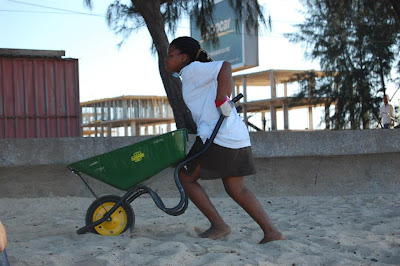
Looking at the effort the girl in the photo I’m reminded of the quote:
 |
| Starting point where participants picked up gloves, masks, bags, and rakes. Groups of 4 people were organized to pick paper and cardboard, plastic, glass and cans. |
According to the Mercer Health and Sanitation Index, Mozambique “suffers from lack of sanitation processes--specifically the lack of a solid waste removal system as well as sewage treatment. The capital city of Maputo feels the worst of these consequences. Piles of garbage line the streets, and the sewage in the river is visibly thick.” Mmmm. Nice.
Dirty beaches? Reason enough to join the initiative to clean the beach of Costa del Sol, north from the city (if we had done it along the Atlantic coast why not do it along the Indian Ocean?). The event was organized by the Department for Social Responsibility of the Bank Millenium BIM, the Portuguese School, the Primary School Polana Caniço A and the NGO Associação Moçambicana de Reciclagem (A.M.O.R.).
 | ||
| Lots of work to do |
Work started early to avoid the heat, but people kept on joining throughout the morning.
Glass bottles, plastic bottles, cans, plastic bags, food wraps, styrofoam containers, juice boxes, cigarette butts ... and much more. We found a lot of everything.


Kids were in general very helpful, but some seemed more prepared than others. One of the youngest ones who had not yet received a bag, collaborated by bringing garbage to add to my bag. I thanked him but had to explain to him that ‘garbage’ didn’t include wood, seaweed, or leaves.
 |
| Event the youngest ones collaborated |
Then, when I saw he was picking stuff without gloves, I offered mine. Without saying a word he took a pair out of his pocket: it was just too hot to wear them and he decided to do without.
After a bit more explaining on my part, we continued picking, this time only garbage and with the gloves on. I wasn’t able to get more than a yes or no from him, but we did fill two bags rather quickly.

 |
| Impressed by the enthusiasm of this little one |
 |
| Fadi didn’t leave even the tiniest shred of glass behind |
At the arrival one of the containers of A.M.O.R. or Ecopoints, organizers selected the recyclable material.
 |
| Arrival point: Ecopoint |
Exhausted participants were welcomed with refreshments after the long walk along the beach under the sun.


Later there was live music, games for the kids to learn to separate materials, competitions, races, building of sandcastles and kite flying.
Looking at the effort the girl in the photo I’m reminded of the quote:
“Never doubt that a small group of thoughtful, committed citizens can change the world. Indeed, it is the only thing that ever has”.

Día de limpieza de playas en Costa del Sol, Maputo
Maputo, la capital de Mozambique, tiene la triste fama de estar entre las 25 ciudades más sucias del mundo.
Según del index de salud y sanidad Mercer, Mozambique “suffers from lack of sanitation processes--specifically the lack of a solid waste removal system as well as sewage treatment. The capital city of Maputo feels the worst of these consequences. Piles of garbage line the streets, and the sewage in the river is visibly thick.” Mmmm. Lindo.
Es por eso que aprovechamos la oportunidad de participar (si lo habíamos hecho en el Atlántico, ¿por qué no en el Índico?) en la iniciativa de limpieza de la playa de Costa del Sol, al norte de la ciudad. El evento estuvo organizado por el departamento de responsabilidad social de el Banco Millenium BIM, la Escuela Portuguesa, la Escuela Primaria da Polana Caniço A y la organización no gubernamental Associação Moçambicana de Reciclagem (A.M.O.R.).
Se empezó temprano para evitar el calor del mediodía, pero siguió sumándose gente toda la mañana.
Botellas de cerveza de vidrio, latas de referezco, paquetes y colillas de cigarrillos, bolsas, botellas de agua de plástico, envoltorios de comida, cajas de jugos de cartón, tapitas de metal, embalajes de styrofoam... encontramos basura de todo tipo.
En general, todos demostraban muy buena voluntad, pero algunos de los niños parecían más preparados que otros. Uno de los niños de la escuela primaria, en vista que no le habían entregado una bolsa todavía, empezó tímidamente a alcanzarme basura para agregar a mi bolsa. Pero parecía que no le habían explicado muy bien en qué consistía el asunto del reciclaje, porque me traía pedazos de madera, algas, hojas.
Cuando además vi que estaba juntando las cosas sin los guantes le ofrecí uno de los míos. Sin decirme una palabra, sacó los suyos del bolsillo de su pantalón: simplemente hacía demasiado calor para usarlos.
Explicación mía mediante, seguimos juntando sólo basura y con los guantes puestos. En todo el trayecto no logré sacarle más que un sí o un no, pero enseguida llenamos dos bolsas enteras.
A la llegada, estaba uno de los contenedores de A.M.O.R., los “Ecopontos”, donde las gestoras organizaban la selección de material reciclable.
A los participantes agotados después de la caminata por la arena al rayo del sol los esperaban con refrescos y merienda.
|
| Punto de partida, donde se le entregaba a los participantes guantes, máscaras, bolsas y rastrillos. Se organizaron partidas de cuatro personas cada una para recoger papel, plástico, vidrio y latas. |
Según del index de salud y sanidad Mercer, Mozambique “suffers from lack of sanitation processes--specifically the lack of a solid waste removal system as well as sewage treatment. The capital city of Maputo feels the worst of these consequences. Piles of garbage line the streets, and the sewage in the river is visibly thick.” Mmmm. Lindo.
Es por eso que aprovechamos la oportunidad de participar (si lo habíamos hecho en el Atlántico, ¿por qué no en el Índico?) en la iniciativa de limpieza de la playa de Costa del Sol, al norte de la ciudad. El evento estuvo organizado por el departamento de responsabilidad social de el Banco Millenium BIM, la Escuela Portuguesa, la Escuela Primaria da Polana Caniço A y la organización no gubernamental Associação Moçambicana de Reciclagem (A.M.O.R.).
| ||
| Mucho trabajo por hacer |
Botellas de cerveza de vidrio, latas de referezco, paquetes y colillas de cigarrillos, bolsas, botellas de agua de plástico, envoltorios de comida, cajas de jugos de cartón, tapitas de metal, embalajes de styrofoam... encontramos basura de todo tipo.
En general, todos demostraban muy buena voluntad, pero algunos de los niños parecían más preparados que otros. Uno de los niños de la escuela primaria, en vista que no le habían entregado una bolsa todavía, empezó tímidamente a alcanzarme basura para agregar a mi bolsa. Pero parecía que no le habían explicado muy bien en qué consistía el asunto del reciclaje, porque me traía pedazos de madera, algas, hojas.
|
| Hasta los más chiquitos colaboraron |
Cuando además vi que estaba juntando las cosas sin los guantes le ofrecí uno de los míos. Sin decirme una palabra, sacó los suyos del bolsillo de su pantalón: simplemente hacía demasiado calor para usarlos.
Explicación mía mediante, seguimos juntando sólo basura y con los guantes puestos. En todo el trayecto no logré sacarle más que un sí o un no, pero enseguida llenamos dos bolsas enteras.
|
| Impresionada por el entusiasmo de este chiquito |
|
| Fadi no dejó que se le escapara ni el más mínimo pedacito de vidrio |
A la llegada, estaba uno de los contenedores de A.M.O.R., los “Ecopontos”, donde las gestoras organizaban la selección de material reciclable.
|
| Punto de llegada: Ecoponto |
A los participantes agotados después de la caminata por la arena al rayo del sol los esperaban con refrescos y merienda.
Más tarde hubo música en vivo, juegos para aprender a separar los diferentes materiales, carreras cargando agua en la cabeza, competencias de construcción de castillos de arena y diversión con cometas para todos los niños.
Viendo el esfuerzo que pone la gurisa de esta foto, me recuerda la cita
“Nunca dudes que un pequeño grupo de ciudadanos considerados y comprometidos pueda cambiar el mundo. De hecho, es la única cosa que ha logrado hacerlo.”
Subscribe to:
Posts (Atom)