Went to see a community screening of the documentary “Play again.” First time I heard the concept of “nature deficit disorder,” that is, that “human beings, especially children, are spending less time outdoors resulting in a wide range of behavioral problems.” If you don’t believe it, just watch the documentary.
Here’s the official trailer. If you’re a parent or have children in your life, you should watch it! (and do something about it)
Showing posts with label children. Show all posts
Showing posts with label children. Show all posts
Sunday, August 10, 2014


Monday, September 2, 2013
If every adult had it that clear...
I’m thinking if there’s one good thing this generation did is having kids like these ones.
If you wanted to have a clear picture about what’s going on in terms of politics and society in Egypt, ask 12-year-old Ali Ahmed. I would vote this kid for president:
And what about our food, GMOs, non-patented seeds? Listen to what 11-year-old Birke Baher has to say:
I can’t wait for this kids to take over the world.
Feeling hopeful...
If you wanted to have a clear picture about what’s going on in terms of politics and society in Egypt, ask 12-year-old Ali Ahmed. I would vote this kid for president:
About the right of children (specially girls) to education? Find out about what 15-year-old Malala Yousafzai has to say. Here is her story:
And what about our food, GMOs, non-patented seeds? Listen to what 11-year-old Birke Baher has to say:
I can’t wait for this kids to take over the world.
Feeling hopeful...
Sunday, July 28, 2013
International aid: A matter of perspectives / Ajuda internacional: Uma questão de perspectiva

(esquerda) Os meninos na America são obligados a passar 8 horas sentados nas aulas, depois eles são drogados quando movem-se ou fazem barulho demais, e sua principal fonte de diversão é a televisão.
(direita) Isso é horrível! Deveria-mos pedir doações para eles.
Wednesday, March 13, 2013
Lions-humans relationships solved by a very smart kid
Meet Richard Turere, a 13-year old Kenyan that is really, really smart. With a lot of ingenuity and the will to solve a problem, he found a very simple solution to keep lions away from his fathers' cattle.
Check his story here:
In Mozambique we have also found bright young people coming up with creative solutions to everyday challenges, looking for ways to do things better, and finding smart, simple answers that were a win-win for everyone. Often, we also found that they were not heard, their opinions not valued, their contributions discounted, their efforts not recognized. I'm posting this to recognize them. And in the hope that this situation will soon change...
Check his story here:
In Mozambique we have also found bright young people coming up with creative solutions to everyday challenges, looking for ways to do things better, and finding smart, simple answers that were a win-win for everyone. Often, we also found that they were not heard, their opinions not valued, their contributions discounted, their efforts not recognized. I'm posting this to recognize them. And in the hope that this situation will soon change...
Sunday, December 16, 2012
Graduación en el kinder: el futuro de Mozambique se ve prometedor en los ojos de estos chiquis

 Quería compartir estas fotos de la ceremonia de graduación, porque las encontré fantásticas.
Me parece que hablan de la energía, esperanza y potencial que se respira alrededor de los niñitos mozambicanos que comenté hace unas semanas.
No digo nada más, las fotos creo que son más que suficientes.


Fotos sacadas por Boaventura Nguenha, miembro de la Asociación Cultural Bonga Mbilo.
Si quieren saber más de como apoyar la educación de estos pequeños, lean acá.
Fundraising for Bonga Mbilo's pre-school in Chamanculo
In a previous posting I had talked about the work that Bonga Mbilo Cultural Association was doing in the most needed areas of Maputo. Among them, a community preschool in the neighborhood of Chamanculo.
One of the issues we had been discussing with the directors was the plan to offer full-day services. For that, one major obstacle was having a place for the 4- and 5-year-olds to have their afternoon nap. They were thinking about beds, but they were too costly and took too much space. Plus who wants to deal with the mess of mattresses used by small children?
 That's when I remembered the soft mats I'd seen in preschools and children rooms, those that come in the form of puzzle pieces. They would be a good option: cheaper than beds and easier to store, in addition to being more fun. I even found out (after chasing a guy who was carrying one of those pieces down the street and following him to his car to ask his wife where did they bought them...) that you could buy them in Maputo in one of the big stores. But when I found them they were very blah and too expensive. What to do? Find an alternative!
 I had also seen around yoga and camping mats for a better price, some with pretty, cheerful colors and some child-like-enough designs. Still easy to clean and store. We calculated that we would need about 30 mats for the 60 children that the preschool was receiving each day. Mats it is. Now, time to fund-raise!
With little time to organize a proper fundraising, I picked everything around the house I thought I could sell. Lucky for us, lovely couple Limaya Bokassa and Andrés Panera were settling in their new apartment and agreed to buy some of the stuff to support the kids. (Thank you guys! You rock!)
 My donation of the one mat I had and the money gathered through the selling of household stuff turned into 5 mats. We still have a way to go to gather the 30 mats needed, but it's a start.
The rest of the household stuff were donated to Bonga Mbilo in the hopes that a garage-sale-style of fundraising event could bring a little bit more $ to buy the rest of the mats. Let's hope next year, the organization will be able to offer a safe place for the children to stay all day long.
One of the issues we had been discussing with the directors was the plan to offer full-day services. For that, one major obstacle was having a place for the 4- and 5-year-olds to have their afternoon nap. They were thinking about beds, but they were too costly and took too much space. Plus who wants to deal with the mess of mattresses used by small children?

With little time to organize a proper fundraising, I picked everything around the house I thought I could sell. Lucky for us, lovely couple Limaya Bokassa and Andrés Panera were settling in their new apartment and agreed to buy some of the stuff to support the kids. (Thank you guys! You rock!)

The rest of the household stuff were donated to Bonga Mbilo in the hopes that a garage-sale-style of fundraising event could bring a little bit more $ to buy the rest of the mats. Let's hope next year, the organization will be able to offer a safe place for the children to stay all day long.
Tuesday, October 30, 2012
About life and death
My grandma died today. She was 2 months short of being 100 years old.
For the past 6 months I've been living in a country where that longevity is inconceivable. In Mozambique, life expectancy hovers around 40 years old. That would be me. In Mozambique, only 3% of the population makes it past 65 years old. That's my parents. In Mozambique, almost half the population is under 15 years old. In the countries I come from, the age structure for the population looks like an inverted pyramid: there are many more older people than younger ones, and the population is growing older. Not in Mozambique.
Let me translate this into images. In Uruguay, it means getting into a bus and be surrounded by a sea of white and grey heads. Mozambique, on the other hand, looks more like the swarm of hundreds of bouncing, laughing, dancing 6- and 7-year-olds at the primary school near our apartment. Those differences in the demographics of a country's population have huge consequences in everyday life, the choices one makes, the problems a society faces.
During the past 6 months I found myself often in the (for me) unusual situation of being the oldest and most experienced in the room. I also found myself turning around to look with tenderness at the rare white-haired, wrinkled person I passed by on the streets. I wanted to go, hug them, and say: "Good for you! You made it!" They would truly deserve it: surviving to an advance age is not easy here. According to UNICEF Moçambique, for a child to make it pass their 5th birthday, they'll have to overcome from "birth complications to pneumonia, diarrhea and malaria, to a lack of clean water and sanitation, to nutrition problems." I wouldn't have made it.
Yet, despite how difficult it is to reach old age, old people don't seem to be valued. Too often, an old person in Mozambique is a marginalized person, someone who can become a victim accused of witchcraft. I'm guessing that has something to do with scarce resources that makes older people be seen as a burden, or a freak of nature - but I'm still wrapping my head around that one.
And then, there's the crazy number of children and young people. That means that the country is vibrating with new energy, pure promise and potential. The buzz is contagious, but it also means you have to provide education and jobs for all these kids or face a potential time bomb in the not-so-distant future. According to the CIA World Factbook "[c]ountries with young populations (high percentage under age 15) need to invest more in schools ... The age structure can also be used to help predict potential political issues. For example, the rapid growth of a young adult population unable to find employment can lead to unrest." When you pair that with the adult population dying of AIDS at an alarming rate, leaving so many orphaned children behind, well...
I had studied and written about these issues before, but living around that reality, you learn what those numbers and statistics mean at an individual level. You learn that funerals are such a common social occasion. That you might from one day to another become responsible for raising 3 or 4 other children from a relative who just passed away. In that context, planning doesn't make that much sense at all. Anything you try to accomplish needs to be filtered through the lenses of what a Mozambican life span is, because, if you expect to die at 40 your priorities are likely to be very different than if you expect to live up to a 100.
For the past 6 months I've been living in a country where that longevity is inconceivable. In Mozambique, life expectancy hovers around 40 years old. That would be me. In Mozambique, only 3% of the population makes it past 65 years old. That's my parents. In Mozambique, almost half the population is under 15 years old. In the countries I come from, the age structure for the population looks like an inverted pyramid: there are many more older people than younger ones, and the population is growing older. Not in Mozambique.
 |
| Three generations |
During the past 6 months I found myself often in the (for me) unusual situation of being the oldest and most experienced in the room. I also found myself turning around to look with tenderness at the rare white-haired, wrinkled person I passed by on the streets. I wanted to go, hug them, and say: "Good for you! You made it!" They would truly deserve it: surviving to an advance age is not easy here. According to UNICEF Moçambique, for a child to make it pass their 5th birthday, they'll have to overcome from "birth complications to pneumonia, diarrhea and malaria, to a lack of clean water and sanitation, to nutrition problems." I wouldn't have made it.
Yet, despite how difficult it is to reach old age, old people don't seem to be valued. Too often, an old person in Mozambique is a marginalized person, someone who can become a victim accused of witchcraft. I'm guessing that has something to do with scarce resources that makes older people be seen as a burden, or a freak of nature - but I'm still wrapping my head around that one.
And then, there's the crazy number of children and young people. That means that the country is vibrating with new energy, pure promise and potential. The buzz is contagious, but it also means you have to provide education and jobs for all these kids or face a potential time bomb in the not-so-distant future. According to the CIA World Factbook "[c]ountries with young populations (high percentage under age 15) need to invest more in schools ... The age structure can also be used to help predict potential political issues. For example, the rapid growth of a young adult population unable to find employment can lead to unrest." When you pair that with the adult population dying of AIDS at an alarming rate, leaving so many orphaned children behind, well...
I had studied and written about these issues before, but living around that reality, you learn what those numbers and statistics mean at an individual level. You learn that funerals are such a common social occasion. That you might from one day to another become responsible for raising 3 or 4 other children from a relative who just passed away. In that context, planning doesn't make that much sense at all. Anything you try to accomplish needs to be filtered through the lenses of what a Mozambican life span is, because, if you expect to die at 40 your priorities are likely to be very different than if you expect to live up to a 100.
 |
| And the fourth generation - spanning 98 years. |
Thursday, October 25, 2012
Embracing reading / Actividades pro-lectura
En una entrada anterior mencioné el problema del analfabetismo y la falta de material de lectura en Mozambique. No es fácil cambiar las cosas de un día para otro, pero muchos están tratando. Además de la organización Livro Aberto, que se enfoca en los más chiquititos, otros activistas mozambicanos se han estado moviendo para resolver el tema de la lectura y el acceso a libros.
Una iniciativa que se llevó a cabo el fin de semana pasado fue la Primera Muestra de Literatura Infantil organizado por el Movimiento Literario Kuphaluxa. Conocí a uno de ellos durante el taller de escritores y me contó de los esfuerzos de un grupo de poetas y escritores locales por generar una cultura de la lectura ya desde pequeños.

Este fin de semana próximo otro evento organizado por Lúcia Fumo se enfoca en facilitar el acceso a libros. Es la Primera Feria de Intercambio de Libros Usados. ¿Los datos?
Escreve lucfumo@gmail.com
Tens livros para doar?
Una iniciativa que se llevó a cabo el fin de semana pasado fue la Primera Muestra de Literatura Infantil organizado por el Movimiento Literario Kuphaluxa. Conocí a uno de ellos durante el taller de escritores y me contó de los esfuerzos de un grupo de poetas y escritores locales por generar una cultura de la lectura ya desde pequeños.

Este fin de semana próximo otro evento organizado por Lúcia Fumo se enfoca en facilitar el acceso a libros. Es la Primera Feria de Intercambio de Libros Usados. ¿Los datos?
Quando?
Domingo 28 Outubro a partir das 11h Onde?
Feima - Feira de Artesanato de MaputoParque dos Continuadores
O que?
Intercambio de livros usados. Traz um ou mais livros para fazer a troca!
Mais alguma coisa?
Oficina de Pintura de capas de livro em Cartão
Oficina de Leitura
Declamação de poesia
Conversa com escritores e autores
Como não podia faltar: musica e dança
Ainda mais perguntas?
Liga 82 525 4090 Escreve lucfumo@gmail.com
Tens livros para doar?
São bemvindos!
Arranja com os organizadores
no número / email aqui acima.
Tuesday, September 18, 2012
The little organization that could

 |
| Teatro y danza en los primeros días. (c) Bonga Mbilo |
Esta organización se llama Bonga Mbilo, que en shangana viene a ser algo así como corazón apasionado por cambios. Basta con decir que que el logo original incluía un escudo guerrero y dos lanzas.
Es una organización que existe hace años. Comenzó con un grupo de artistas con vocación comunitaria y paulatinamente se ha ido volcando a prestar servicios a la comunidad - especialmente en Chamanculo, uno de los barrios pobres de Maputo de los que ya había hablado.
Otra gente ya venía colaborando con ellos informalmente; Fadi tomó el proyecto y les ayudó a terminar la instalación de un centro de informática, laboral y de recursos para jóvenes.
 |
| Fiesta a la salida de la guardería. (c) Bonga Mbilo |
En la guardería tienen a niños de 4 y 5 años y les dan desayuno y almuerzo y actividades durante la mañana. En este momento están viendo cómo conseguir los recursos necesarios para poder ofrecer servicio de guardería todo el día.
El otro programa salió a raíz de que ganaron un concurso de la intendencia para proveer servicios de recolección de residuos a una sección de la ciudad, un barrio adyacente de Chamanculo donde tampoco hay saneamiento ni recolección. Intentaron hacer reciclaje sin mucho éxito pero querrían volver a intentarlo con la información adecuada.
 |
| Con el presidente Sr. Paulo Cossa frente a la oficina de Bonga Mbilo. El gurí pasaba por ahí y como se quedó mirando lo invité a que se sacara una fotos con nosotros. |
Como mi trabajo en la Universidad Pedagógica me dejaba tiempo para otras cosas estoy ayudando a tiempo parcial a esta organización.
Después de unas reuniones con el presidente y el director y unas visitas a la guardería y las oficinas para presentarme a otros colaboradores, estuvimos todos de acuerdo en que podía ayudarlos a rever lo que estaban haciendo, re-organizarse y crear un plan de acción para fortalecer a la asociación y hacerla sustentable.
 |
| Con el director Sr. Enosse Michangula |
Hemos tenido ya varias reuniones en el centro para planear, informar, responder a sus dudas y en general acompañarlos en la toma de decisiones en este proceso de restructura de la organización. Trabajar con este equipo, que incluye dos de los miembros más jóvenes de la organización, Epifânia y Boaventura, ha sido un placer. Super buena actitud, ganas de aprender y de cambiar cosas. Realmente Bonga Mbilo.
Puesta al día [diciembre 2012]: la página ya está en internet, con mucho todavía por hacer pero un gran paso adelante.
Wednesday, July 18, 2012
Cleaning day at the Costa del Sol beach in Maputo: a community effort
Maputo, Mozambique’s capital, is infamous for being among the 25 dirtiest cities in the world.
According to the Mercer Health and Sanitation Index, Mozambique “suffers from lack of sanitation processes--specifically the lack of a solid waste removal system as well as sewage treatment. The capital city of Maputo feels the worst of these consequences. Piles of garbage line the streets, and the sewage in the river is visibly thick.” Mmmm. Nice.
Dirty beaches? Reason enough to join the initiative to clean the beach of Costa del Sol, north from the city (if we had done it along the Atlantic coast why not do it along the Indian Ocean?). The event was organized by the Department for Social Responsibility of the Bank Millenium BIM, the Portuguese School, the Primary School Polana Caniço A and the NGO Associação Moçambicana de Reciclagem (A.M.O.R.).
Work started early to avoid the heat, but people kept on joining throughout the morning.
Glass bottles, plastic bottles, cans, plastic bags, food wraps, styrofoam containers, juice boxes, cigarette butts ... and much more. We found a lot of everything.


Kids were in general very helpful, but some seemed more prepared than others. One of the youngest ones who had not yet received a bag, collaborated by bringing garbage to add to my bag. I thanked him but had to explain to him that ‘garbage’ didn’t include wood, seaweed, or leaves.
Then, when I saw he was picking stuff without gloves, I offered mine. Without saying a word he took a pair out of his pocket: it was just too hot to wear them and he decided to do without.
After a bit more explaining on my part, we continued picking, this time only garbage and with the gloves on. I wasn’t able to get more than a yes or no from him, but we did fill two bags rather quickly.

At the arrival one of the containers of A.M.O.R. or Ecopoints, organizers selected the recyclable material.
Exhausted participants were welcomed with refreshments after the long walk along the beach under the sun.


Later there was live music, games for the kids to learn to separate materials, competitions, races, building of sandcastles and kite flying.
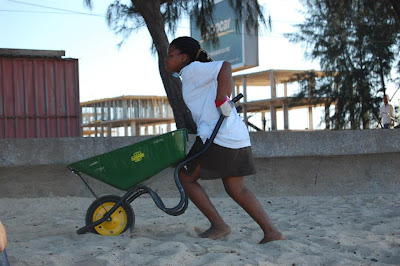
Looking at the effort the girl in the photo I’m reminded of the quote:
 |
| Starting point where participants picked up gloves, masks, bags, and rakes. Groups of 4 people were organized to pick paper and cardboard, plastic, glass and cans. |
According to the Mercer Health and Sanitation Index, Mozambique “suffers from lack of sanitation processes--specifically the lack of a solid waste removal system as well as sewage treatment. The capital city of Maputo feels the worst of these consequences. Piles of garbage line the streets, and the sewage in the river is visibly thick.” Mmmm. Nice.
Dirty beaches? Reason enough to join the initiative to clean the beach of Costa del Sol, north from the city (if we had done it along the Atlantic coast why not do it along the Indian Ocean?). The event was organized by the Department for Social Responsibility of the Bank Millenium BIM, the Portuguese School, the Primary School Polana Caniço A and the NGO Associação Moçambicana de Reciclagem (A.M.O.R.).
 | ||
| Lots of work to do |
Work started early to avoid the heat, but people kept on joining throughout the morning.
Glass bottles, plastic bottles, cans, plastic bags, food wraps, styrofoam containers, juice boxes, cigarette butts ... and much more. We found a lot of everything.


Kids were in general very helpful, but some seemed more prepared than others. One of the youngest ones who had not yet received a bag, collaborated by bringing garbage to add to my bag. I thanked him but had to explain to him that ‘garbage’ didn’t include wood, seaweed, or leaves.
 |
| Event the youngest ones collaborated |
Then, when I saw he was picking stuff without gloves, I offered mine. Without saying a word he took a pair out of his pocket: it was just too hot to wear them and he decided to do without.
After a bit more explaining on my part, we continued picking, this time only garbage and with the gloves on. I wasn’t able to get more than a yes or no from him, but we did fill two bags rather quickly.

 |
| Impressed by the enthusiasm of this little one |
 |
| Fadi didn’t leave even the tiniest shred of glass behind |
At the arrival one of the containers of A.M.O.R. or Ecopoints, organizers selected the recyclable material.
 |
| Arrival point: Ecopoint |
Exhausted participants were welcomed with refreshments after the long walk along the beach under the sun.


Later there was live music, games for the kids to learn to separate materials, competitions, races, building of sandcastles and kite flying.
Looking at the effort the girl in the photo I’m reminded of the quote:
“Never doubt that a small group of thoughtful, committed citizens can change the world. Indeed, it is the only thing that ever has”.

Saturday, May 12, 2012
It takes a whole village to raise a child
 Less than 48 hours in Maputo and we’re invited to a party. There, I met a very entrepreneurial young guy. As president of the Associação Cultural Muodjo, he approached me to see how we could collaborate. A couple of days later we met and I interviewed him to find out more about the organization.
As it turns out, this small local organization works with street children, supporting them in a myriad of ways with the help of many volunteers from the same community, as well as national, and international volunteers from Germany, Brazil and other countries.
They do provide daily services to 60+ kids, quite a feat given the very limited material resources they have. Some of the organization’s most pressing needs? A steady source of funds, permanent and trained staff, food, educational materials, a new building that allow them to provide workshops, donors who would like to sponsor the expenses of the kids’ schooling. What they lack in things, they more than compensate with human input.
Want to know more? Here is an extract from Muodjo's strategic plan:
Not all street children are orphans. A considerable proportion of the children we work with surely know how to answer the following questions:
- Where they lived before opting for the life of the street
- What were the reasons for leaving home
- Who lived in the house they left
- What would they like to be in the future
In some cases parents know the whereabouts of the child but are not interested in seeking and bringing them back. This indicates the need for a program to create awareness among parents, extended families or possible surrogate for subsequent reintegration, and continuous monitoring.
BOARDING, EDUCATION & ASSISTANCE SCHOOL
The ideal would be to reinstate all children back with their families, but this is no always possible. For this reason, the organization aims to provide a boarding school, a place where they can obtain social assistance to attend school and be provided with life skills training.
Even with this short abstract, it’s clear that the challenges are manifold. To support the approximately 600,000 orphan children in the country many other organizations are trying to do what they can, sometimes with minimal resources as this one.
Subscribe to:
Posts (Atom)